Bastián Henríquez-Jara, Thomas O. Hancock, Albert Solernou, Jorge García, C. Ángelo Guevara, Charisma Choudhury Abstract The effect of experiences on travel mode choices is well established in the literature. Additionally, there is evidence that psychophysiological signals, such as skin conductance, can capture travel experiences without relying on self-reported measures, given their strong correlation with psychological states. However, using physiological data to estimate... read more →
Oct
16
Oct
16
Andrea Pellegrini, Andrés Fielbaum Abstract On-demand ridepooling benefits from updating its routing decisions in real-time as new information becomes available, as well as from optimising the pickup and dropoff (PUDO) points to avoid long detours. Both features indicate that it could be plausible to implement flexible walking, i.e., deciding the PUDO points dynamically, as... read more →
Oct
16
Andrés Fielbaum Abstract This paper investigates the coordination costs associated with how vehicles and passengers meet in space, in any mode where the vehicle is not owned by the passenger. We introduce a novel categorisation contrasting Assigned modes (where each user has a designated vehicle) with Onsite modes (where users take... read more →
Oct
16
Haoning Xi, John D. Nelson, Corinne Mulley, David A. Hensher, Chinh Q. Ho, Camila Balbontin Abstract This study explores the potential for integrated mobility services in a regional and rural context. In-depth interviews of stakeholders, including Non-Transport Providers and Transport Providers, were conducted in three regional locations in New South Wales, Australia. Findings revealed that the majority had a positive attitude... read more →
Oct
16
Marta Contreras, Alondra Chamorro, Nikole Guerrero, Carolina Martínez, Tomás Echaveguren, Eduardo Allen and Nicolás C. Bronfman Abstract Road networks are essential for access, resource distribution, and population evacuation during natural events. These challenges are pronounced in rural areas, where network redundancy is limited and communities may have social disparities. While... read more →
Oct
10
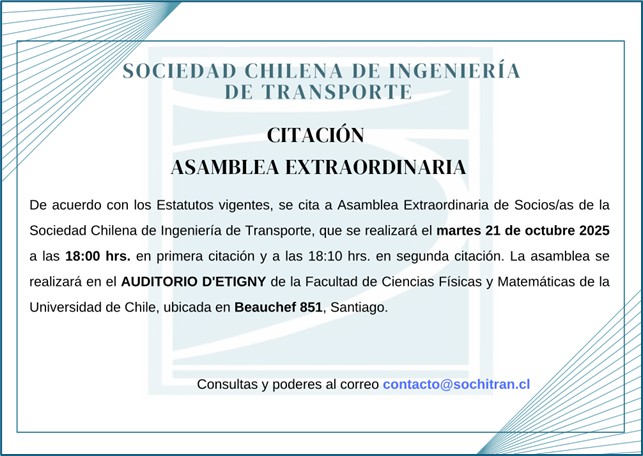
De acuerdo con los Estatutos vigentes, se cita a Asamblea Extraordinaria de Socios/as de la Sociedad Chilena de Ingeniería de Transporte, que se realizará el martes 21 de octubre a las 18:00 hrs. en primera citación y a las 18:10 hrs. en segunda citación. La asamblea se realizará en el... read more →
Sep
29
por Mauricio Casanova, Director de Inteligencia de Datos y Margarita Amaya (Directora Sochitran), Coordinadora Ejecutiva. Conecta Logística En Chile, las cuentas nacionales del sector Transporte y almacenamiento incluyen actividades relacionadas a la carga y los pasajeros, lo que mimetiza las diferencias e invisibiliza sus relaciones con otros sectores económicos. Un... read more →
Sep
26
por Luis Rizzi, Profesor Asociado del Departamento de Ingeniería de Transporte y Logística PUC y Director Asociado de la Dirección de Postgrado de la Escuela de Ingeniería PUC. Socio Sochitran. Con relación a personas fallecidas en accidentes de tránsito, Carabineros de Chile reporta valores que oscilan entre 1.500 y 1.700... read more →
Sep
26
Tiznado-Aitken, I., Vecchio. G., Astroza, S., Carrasco, J.A. & Smith Piel, C. (2025). Profiling caregivers: Caregiving workload, mobility, stress, and remote work difficulties. Urban Studies (Special issue: Urban Transport as a Social Construct). DOI: https://doi.org/10.1177/00420980251361626 ¿Cuál es el gap que buscaban resolver y por qué es importante? En este artículo buscamos contribuir con... read more →
Sep
11
Göran Smith y Camila Balbontín Abstract There is a fundamental tension between user convenience and system efficiency in transport. This workshop set out to bridge the discussions on user-centric mobility with those on transport justice and sustainable transport. Based on eleven papers offering insights into public transport user groups and preferences, post-pandemic... read more →